BEHIND THE MASK
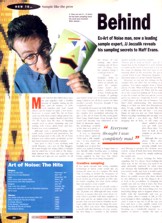
Ex-Art of Noise man, now a leading sample expert, JJ Jeczalik reveals his sampling secrets to Maff Evans.
MOST DANCE RECORDS these days are put together with a healthy amount of samples taking up the mix, and all manner of yells, vocal snatches and “real” sound effects can be on quite a few tracks. However, it wasn’t until The Art of Noise came up with their sound collage pieces (including the classic singles Beatbox and Close (To The Edit) that the idea of blending sounds such as doors slamming and cars starting with voices, drum beats and keyboards was even considered.
Although such a ground-breaking style could be seem contrived and pretentious, the actual background of the early Art of Noise releases was rather more accidental, as former band member JJ Jeczalik explains.
“Just prior to that I was working with Geoff Downes, who was in The Buggles. He’d just bought this thing called a Fairlight and he asked me to look after it. My immediate interest was, ‘What can I get into this and what can I get out very quickly?’ So all the noises of cars starting and doors banging and all those sorts of things were the simplest things I could get hold of.”
Despite the Fairlight’s ability to drop in sounds anywhere at virtually any pitch, JJ’s sample-clutter wasn’t altogether well-received at first: I built up this stockpile of garbage and when I went over to freelance programming, I tried to use all these noises on other people’s records. Everyone thought I was completely mad!”
Eventually JJ teamed up with fellow engineer Gary Langham to start working with the samples he’d stockpiled, releasing singles as the Art of Noise for the avant-garde label Zang Tumb-Tuum. Even though their sounds had become very influential in the field of electronic music, the technology available at the time was pretty archaic compared to today.
“It was so disgusting in those days,” agrees JJ, “8-bit and 28k sample-rate – it was monstrous. In the early days, the Fairlight was so poor that when you started looking at longer times it was literally either hearing gaps or making bits up. Certain sounds seemed to help being sampled in that way, but others sounded like the worst thing imaginable.”
Creative sampling
JJ has spent enough time using sampling technology to know some useful tips on getting the most out of a sampler. We dealt with recording at double the frequency of your highest pitch and making sure that the levels mat up at loop points in FM4’s tips for better sampling, but what about adding that vital spark to your sounds?
“The number-one tip for people using a sampler for the first time is to read the manual,” JJ points out. Although this may sound obvious, it ensures that new users know exactly what is possible with their samplers. A tool may just be an added extra for many people, but you never know whether an obscure utility may be just the thing for creating the effect you need. After familiarising yourself with the functions on your system, the first thing to consider is the method used to actually record the samples.
“You’ve got to look at levels,” says JJ. “I found that in the Fairlight II it really helped to crank up the level so much that it was on the verge of clipping. That had quite an interesting effect on the waveform. We got to a point where it was “Maximum Disgusto” – distortion times 13 on the Tufnell Theorem.”
However, it is not just the settings on the sampler that can affect the recording, as JJ explains: “I’ve taken samples from a Dictaphone. It’s like ‘What will that mic do? What will that compressor do? What will the tape do to the sound I’m putting in?’ If you want to get the soud out that you put in, you’ve got to use direct in – forget the A to D – use a DAT player, all that sort of business, but that’s fairly uninteresting. The interesting thing to do is to find out what that [Dictaphone] does. To me, a little tape recorder like that is like an MXR in the old days – you plug things in and you just see what happens. When you plug something into an amp, you fiddle with it – you don’t say, “Well I’m plugging this in here, so it’ll come out there,” which is what you get with samplers these days. You have to look at the sampler as an effects box too.”
Although the emphasis these days seems to be on improving sample rates and filtering to produce the cleanest, most realistic sound, JJ finds that more interesting effects can be created by simply reducing the sample rate.
“People are always looking for better sampling, but I’ve always been looking the other way. In the old days you used to be quite pleasantly surprised by what came out, because the bandwidth was such that you weren’t really sure how it would sound. Now, with high-bandwidth machines, there’s no earthly reason why there should be any difference at all. The thing to do is to look at the possibilities of changing the sample rate and see what it does. See what actually happens and whether you like it. You may think it’s the worst thing ever, but interesting things start to happen when you fiddle with the bandwidth and you go down. Quite often I sample at 28k or 15k, even though if offers sampling at 44.1k, because I want to get rid of all the top and bass and have a nice middly sound with nothing in it at all, kind of like a ‘snapshot’.” Deciding on a bandwidth depends on a number of factors – mainly, the type of sound to be sampled and how it is to be used in a mix.
“If you’ve got full-bandwidth samples competing with very low-bandwidth sounds, by which I mean 14k or 15k, then obviously you’re going to have disparity between them when you try and balance it up. One’s going to have loads of weight and lots of frequencies and the other one isn’t because they’re not there. So it’s a matter of seeing how it all fits together. Sustained voice sounds are ideal for nice middle-low-bandwidth sampling, because there’s not a lot there anyway. If you want something in a mix that’s just going to sit back and doesn’t have much weight then that’s an ideal time to start sampling things at low bandwidth, but if you want the weight then you have to go for the full rate. All the early Art of Noise stuff was done at about 14k, but because it was all recorded like that it doesn’t sound too bad and of course the keyboards jump out and hit you in the face because they’re at full bandwidth.”
Careful editing
So what about the editing process? There are a few points to watch for when trimming and looping, as JJ explains.
“I like loops because I like programming, but equally some of those things you can’t program. The drums on Close (To The Edi) are a loop called “Track-Boom” because I mis-timed my sample and it starts with a snare. That’s one of the reasons why it’s got such an amazing groove, because it doesn’t start on [beat] one!” Having said this JJ is quick to point out that sample editing isn’t just about loops.
“Unless you’re looping stuff I think about 0.5, 0.7 of a second should really be plenty. In the early days that’s all we had. You were lucky to get a second out of the early machines. Otherwise all it tends to be a matter of pushing a key down and you get all this other stuff, whereas if it’s quite short you’ve got the ability to play live and add a melody or a rhythm. It’s implicitly more interesting, because you’re then doing something with it rather than just repeating it.”
One trap that many people fall into is spending a long time editing samples that aren’t necessarily going to be used. It’s a fiddly process and can be a waste of time.
“Sometimes when I’ve got the screen up, I trim it up and then it’s done,” says JJ. “I only really hone in on it if the feel has changed a bit or it’s not sitting properly because other things have changed around it. The thing you can do is sit there and go crazy – forgetting to save the damn thing in the first place, which is always a disaster – making what you think is the perfect sound and then find that it’s useless. It’s much easier to get something up very quickly, make sure you’ve saved it, get it rolling in the rest of the track and then if you think it needs to be honed down a bit, do it. Otherwise you just end up honing loads and loads of little bits and pieces which are completely unrelated and it’s a total waste of time.”
Saving your work is another key concern.
“Ten minutes is the max,” JJ reckons, “Because then you can always get everything back in ten minutes, but if you’re working for three hours on a series of samples and they all go down the tubes, it’s committed to the ether and that’s it. Bye-bye.”
Newer samplers have the additional benefits of time compression, so you can change the timing of a sample without altering it’s pitch, or vice versa. How can you make changes without that facility?
“You have to do it yourself. I’ll chop it up and re-program it, if it’s a bass drum/snare drum/hi-hat figure that just isn’t working, to see if I can get the same sort of feel at the tempo I wanted.”
Tuning samples is a much more subjected area – the sound of the sample depending very much on who’s listening. “People’s tolerances of tuning vary. I don’t think I’ve got perfect pitch, but my tolerance is sometimes better than others’ and sometimes worse. There have been instances where I’ve said, “That’s so badly out of tune. We’ve got to do something about it,” and other people have said, “There’s no problem.” Then the reverse. It’s a personal thing. If you’ve got a complex sound, then you’re looking at an overall perception of what you hear. Depending on where it is in the mix, what reverbs you put on it and what EQ you put on it, you’ll get a different part of the fundamental coming out of it.”
JJ’s best advice to sampling fiends is to keep a library. “Keep one that’s well organised. Mine is frightening – I’ve got too much and it just sits there. It’s a waste. Five years ago, when I was using the floppies on the [Fairlight] II, I knew where things were because it had a limited library. Now I’ve got tape streamers and optical drives – it’s just ridiculous.”
Small problems aside, JJ’s sampling experience is not to be sniffed at. Budding sample engineers take note. FM
In no sense nonsense – JJ’s advanced sampling techniques
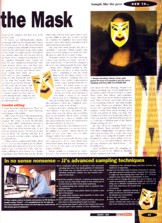
From starter motors to tennis commentary to PW Botha to people saying “Dumm” – JJ’s sampled them all. So take advice from someone who knows his stuff and you could end up the sample guru of tomorrow.
We’ve condensed some of JJ Jeczalik’s most succulent sampling tips in a few handy gobbets of information that should see you placed well on the road towards sampling excellence. Indeed, our cup runneth over – pass me the cloth.
? Read the sampler’s manual – it seems an obvious thing to say, but you may come across a very useful tool or function that you didn’t know about previously.
? Try experimenting with sample rates to produce interesting effects.
? Shift the sample’s loop points about to create a new feel in the groove.
? Try using short samples when possible to allow more scope for experimentation.
? Don’t spend ages horning a sound perfectly until you’re sure that it is actually going to work as a track.
? If a sample loop doesn’t quite fit the timing of the track, and you don’t have access to time compression, try chopping up the individual beats and then recreate the rhythm on a sequencer.
? Don’t be too fiddly when it comes to tuning the sample. Get other people to listen to how it sounds first, because it might not need altering that much after all – different people’s ears have different perceptions of pitch.
? If you want to change the tuning of a sound slightly, you could try outputting it separately through an equaliser to bring out a different fundamental (the part of a sound-wave that determines the overall pitch of a sound).
? Keep a small, organised working library so that you can find the particular sample you need quickly.
? Save your work often.
? Above all, experiment! It is of course, entirely your work, so you’re free to do whatever you feel like trying.