|
ART OF NOISE
Slim's San Francisco
"SHIT. It's the first gig Art Of Noise have ever played in 16 years and Uncut tracks us down half way across the world," Paul Morley says backstage after the band's belated but triumphant live debut.
The band that many credit with inventing sampling years before we had a name for it have waited a long time to make the transition from studio boffins to live act, and they opened a five-date mini-tour of the US at Slim's, a club owned by Boz Scaggs which resembles a larger, San Franciscan version of Camden's Jazz Cafe.
The tour is to promote AON's remarkable album, The Seduction Of Claude Debussy (see Uncut 27 for the full history), and one wonderedjust how its drum'n' bass-meets-classical-soundtrack to an imaginary film about the French composer would translate on stage. That it would do so successfully is obvious from the moment Morley appears, resplendent in a long black trenchcoat and bizarrely wielding a hammer like some avenging judge dispensing summary justice on modern music.
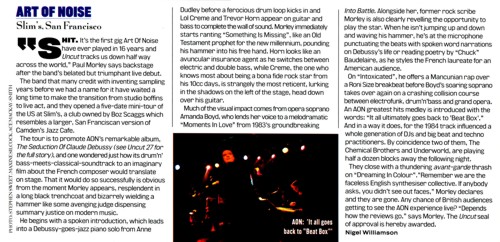
He begins with a spoken introduction, which leads into a Debussy-goes-jazz piano solo from Anne Dudley before a ferocious drum loop kicks in and Lol Creme and Trevor Horn appear on guitar and bass to complete the wall of sound. Morley immediately starts ranting "Something Is Missing", like an Old Testament prophet for the new millennium, pounding his hammer into his free hand. Horn looks like an avuncular insurance agent as he switches between electric and double bass, while Creme, the one who knows most about being a bona fide rock star from his 10cc days, is strangely the most reticent, lurking in the shadows on the left of the stage, head down over his guitar.
Much of the visual impact comes from opera soprano Amanda Boyd, who lends her voice to a melodramatic "Moments In Love" from 1983's groundbreaking Into Battle. Alongside her, former rock scribe Morley is also clearly revelling the opportunity to play the star. When he isn't jumping up and down and waving his hammer, he's at the microphone punctuating the beats with spoken word narrations on Debussy's life or reading poetry by "Chuck" Baudelaire, as he styles the French laureate for an American audience.
On "Intoxicated", he offers a Mancunian rap over a Roni Size breakbeat before Boyd's soaring soprano takes over again on a crashing collision course between electrofunk, drum'n'bass and grand opera. An AON greatest hits medley is introduced with the words: "It all ultimately goes back to 'Beat Box'." And in a way it does, for the 1984 track influenced a whole generation of DJs and big beat and techno practitioners. By coincidence two of them, The Chemical Brothers and Underworld, are playing half a dozen blocks away the following night.
They close with a thundering avant-garde thrash on "Dreaming In Colour". "Remember we are the faceless English synthesiser collective. If anybody asks, you didn't see out faces," Morley declares and they are gone. Any chance of British audiences getting to see the AON experience live? "Depends how the reviews go," says Morley. The Uncut seal of approval is hereby awarded.
Nigel Williamson
|